



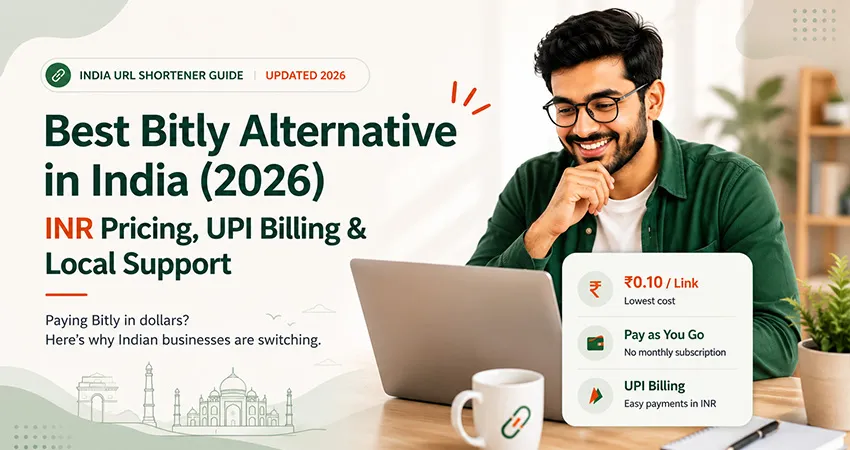
If you run marketing, growth, or engineering for an Indian business, you've probably had this exact moment: you open your Bitly invoice, see a charge in US dollars, watch your bank add a foreign transaction markup on top, and wonder why a tool that shortens links costs more than some of your ad platforms.
You're not imagining it. Bitly, like most SaaS tools built for the US and European markets, prices in dollars, bills through international card networks, and treats India as a secondary market rather than a primary one. For a five-person startup shortening a few hundred links a month, that's an annoyance. For a performance marketing agency running client campaigns at scale, a D2C brand tracking every WhatsApp broadcast, or an enterprise team managing thousands of branded links across regions, it's a real cost.
This guide breaks down why Indian businesses are re-evaluating Bitly in 2026, what a "great" URL shortener actually needs to do beyond shortening links, and how platforms priced and billed for India — like SPRL — stack up on cost, features, and support.
Why Indian Businesses Are Leaving Bitly
Bitly built its reputation as the default link shortener for over a decade, and it earned that reputation. But "default" and "best fit for India" are two different things, and in 2026 the gap between them has become hard to ignore.
Three shifts are driving Indian teams to look elsewhere:
- Usage has outgrown the free tier fast. Every WhatsApp broadcast, SMS campaign, email send, influencer collaboration, print QR code, and paid ad needs a trackable link. Free tiers disappear quickly, and the next tier up is priced for a US marketing budget.
- Marketers want more than a shortener. A link is now a data point — city, device, platform, conversion. Basic shorteners weren't built with this depth in mind, and adding it later usually means paying for a higher tier.
- Billing friction is a real operational cost. Finance teams don't love reconciling USD invoices, chasing GST-compliant billing from a foreign vendor, or explaining international card transactions.
Bitly's Pricing Problem for Indian Companies
Currency Conversion Issues
Bitly prices its plans in US dollars. Every billing cycle, your bank converts that charge into rupees at whatever rate applies that day — not the rate you budgeted for at signup. Over a 12-month contract, currency fluctuation alone can shift your effective cost, and finance teams have no way to predict it in advance.
International Card Problems
Paying a US-billed vendor from India usually means an international-transaction-enabled card, which creates friction at signup and at renewal — failed transactions, RBI authentication issues, expired cards, or bank fraud blocks on foreign charges.
GST and Tax Documentation
Indian businesses need GST-compliant invoices to claim input tax credit and keep books audit-ready. Many international SaaS vendors don't issue GST invoices, or route India billing through import-of-service tax treatment your accountant has to manually handle every cycle.
Dollar Billing at Indian Traffic Volumes
According to SPRL's published pricing comparison (based on publicly available data, subject to change), a Bitly plan covering roughly 3,000 links runs close to ₹14,870/month — around ₹4.96 per link. Rebrandly's comparable tier, covering around 15,000 links, comes in near ₹6,650/month, or roughly ₹0.44 per link. Compare that to a pay-as-you-go model at ₹0.10 per link with no subscription.
The math in plain terms: 1,000 links on a ₹0.10/link model costs ₹100 flat. The same volume on a fixed USD subscription can cost 100x more — whether you use the full plan or not.
UPI Limitations
UPI is how most of India pays for things now. But most global SaaS checkout flows are built around card-first processors that don't support UPI, or support it only partially. Indian founders end up entering card details for a tool they'd rather pay for in five seconds via UPI QR scan.
Why Local Businesses Need an Indian Alternative
- Support in your timezone — a campaign breaking at 11 PM IST shouldn't mean waiting on US business hours.
- DLT compliance awareness — India-regulated SMS/WhatsApp traffic needs redirect structures built with these rules in mind.
- Familiarity with India's channel mix — WhatsApp Business API, SMS, and QR codes on packaging carry outsized weight here.
- Billing that matches Indian finance operations — GST invoices, INR pricing, UPI payments.
What Makes a Great URL Shortener in 2026
The bar has moved well past "makes a long link shorter." At minimum, a modern link platform needs:
Branded Domains
Custom domains that carry your brand, not a generic shortener's.
Real-Time Analytics
Country, city, device, browser and referrer data as clicks happen.
Bulk Creation
CSV upload or API-based generation for campaign-scale link volume.
Dynamic QR Codes
Editable after printing — no reprinting packaging when a link changes.
Geo & Device Targeting
One link, different destinations by location or device type.
Security Controls
Password protection and link expiry for sensitive content.
Developer API
Documented REST API for programmatic link management.
Custom Aliases
Memorable, on-brand slugs instead of random strings.
Bitly vs Rebrandly vs TinyURL vs Dub vs Short.io vs SPRL
A note on fairness: Pricing for Bitly and Rebrandly reflects publicly available data referenced on SPRL's pricing page and is subject to change. Verify current details directly with each vendor.
| Feature | Bitly | Rebrandly | TinyURL | Dub | Short.io | SPRL |
|---|---|---|---|---|---|---|
| Pricing model | Fixed USD tiers | Fixed USD tiers | Free / limited paid | Usage-based, USD | Fixed USD tiers | Pay-as-you-go, ₹0.10/link |
| INR billing | No | No | No | No | No | Yes |
| UPI payment | No | No | No | No | No | Yes |
| GST invoicing | No | No | No | No | No | Yes |
| Real-time analytics | Higher tiers | Higher tiers | Limited | Yes | Higher tiers | Included |
| Bulk shortening | Higher tiers | Higher tiers | No | Yes | Higher tiers | CSV & API |
| QR codes | Higher tiers | Add-on | Basic | Basic | Add-on | Dynamic, editable |
| Developer API | Yes | Yes | Limited | Yes | Yes | Full REST API |
| Geo targeting | Enterprise only | Limited | No | Limited | Limited | Included |
| Device targeting | Enterprise only | No | No | Limited | Limited | Included |
| Password protection | Enterprise only | No | No | No | Limited | Yes |
| India-based support | No | No | No | No | No | Yes (Bengaluru) |
See how your own link volume compares.
Check SPRL's Live Pricing →Why SPRL Stands Out for Indian Teams
Pay-as-you-go pricing, not a subscription tax
SPRL charges ₹0.10 per link, with no monthly subscription and no minimum commitment. 1,000 links work out to a flat ₹100 — no tier to graduate into, no unused capacity you're quietly paying for.
Bulk URL shortening built for campaign-scale work
SPRL's bulk URL shortener takes a CSV upload and returns shortened, trackable links in bulk, with full analytics on each. The same capability is available via API.
Real-time analytics that actually inform decisions
Every link tracks countries, cities, devices, platforms, and referrers in real time — not on a delay.
Dynamic QR codes for a QR-first market
QR codes generated by SPRL are dynamic and editable after printing, downloadable as SVG, PNG, JPG, or WebP, with scan-level analytics.
Geo targeting and device targeting
Route the same short link differently by country or device — one link, multiple destinations.
A developer API built for integration
A documented REST API for generating, managing, and tracking links programmatically.
Password protection, link expiry, custom aliases
Security controls and on-brand aliases included as standard, not gated behind an enterprise tier.
Nested routing suited to India's DLT-regulated channels
Built with India's SMS/WhatsApp DLT requirements in mind — relevant if a meaningful share of outbound marketing runs through those channels.
Try it on your own links.
Create Your First Branded Short Link Free →ROI Comparison: What a Switch Actually Saves
| Metric | Bitly (fixed tier) | SPRL (pay-as-you-go) |
|---|---|---|
| Monthly link volume | 3,000 | 3,000 |
| Monthly cost | ~₹14,870 | ~₹300 |
| Cost per link | ~₹4.96 | ₹0.10 |
| Unused-capacity risk | Yes | None |
| Approx. monthly saving | — | ~₹14,570 |
Figures are illustrative, based on publicly available pricing referenced earlier in this article, and vary with actual usage and current vendor pricing.
India's Digital Growth, By the Numbers
None of the features above matter if the underlying market doesn't justify investing in link infrastructure. It does.
India's Internet Base
900M+
active internet users, driven by mobile-first adoption — per IAMAI/Kantar ICUBE research.
Mobile-First Traffic
~95%
of India's internet access happens via mobile devices — per IAMAI/Kantar research.
Digital Ad Spend
Double-digit
YoY growth reported by Dentsu Digital Report and GroupM's This Year Next Year studies.
Illustrative Click Distribution by Device (SPRL Platform Sample)
Sample distribution shown on SPRL's public dashboard demo (insprl.com), illustrative of typical mobile-heavy Indian click patterns.
Why this matters for your budget: if branded links convert better and your traffic is overwhelmingly mobile, the platform you choose should be judged on custom domain support and device-level targeting — not just raw click-tracking.
Case Study: A Bengaluru Performance Marketing Agency Switches to SPRL
Illustrative scenario reflecting common patterns agencies report when evaluating link management costs — not a specific named client account.
A 14-person performance marketing agency in Bengaluru manages paid social, SMS, and WhatsApp campaigns for eight D2C and retail clients, generating roughly 4,000–5,000 tracking links a month.
On Bitly: a mid-tier plan billed monthly in USD, with periodic overage charges during festive campaigns and international card fees on every charge. Granular geo/device analytics required an enterprise upgrade.
After migrating to SPRL: at ~4,500 links/month, cost worked out to approximately ₹450 — with no overage risk, since cost scales linearly with usage. Geo and device analytics were included by default, letting the agency offer richer client reporting without an upsell. GST-compliant invoicing simplified their accountant's workflow, and UPI payment removed dependency on international-transaction cards.
Running an agency with similar volume?
Try Bulk-Shortening Your Next Campaign →How to Migrate from Bitly to SPRL
- Audit active campaigns and identify live vs. expired Bitly links.
- Set up your branded domain on SPRL.
- Bulk-import your active link list via CSV.
- Run both platforms in parallel for print materials that can't be updated immediately.
- Redirect new campaigns exclusively through SPRL as physical assets naturally cycle out.
Frequently Asked Questions
Final Word
Bitly isn't a bad product — it's a product priced and built for a market that isn't India's. With India's internet base overwhelmingly mobile, QR code usage at habitual levels thanks to UPI, and WhatsApp/SMS carrying real marketing budget, tools built around INR pricing, UPI billing, and local support are simply a better operational fit for Indian teams.